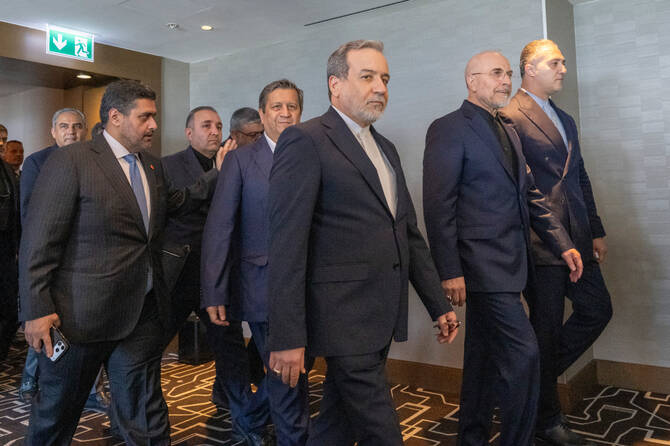
US Warned Iran of Alleged Israeli Threat to Negotiators
DUBAI-The United States asked regional partners to quietly warn Iran that Israel could target two of Tehran’s senior negotiators during ceasefire diplomacy earlier this year, according to a report by The New York Times, reflecting concerns in Washington that any such attack could derail negotiations aimed at ending the conflict.
The newspaper reported that U.S. officials feared Israeli action against Iranian Foreign Minister Abbas Araghchi and Parliament Speaker Mohammad Bagher Ghalibaf while indirect talks over an interim peace arrangement were underway. According to the report, Washington believed the assassination of either official could have jeopardized negotiations that began in April and risked reigniting hostilities.
The reported warning was conveyed through governments in the Middle East acting as intermediaries, allowing Tehran to strengthen security around its negotiating team without direct public communication between Washington and Iranian officials.
According to The New York Times, the episode highlighted growing differences between the United States and Israel over the direction of the conflict. While Washington increasingly prioritized preserving diplomatic negotiations with Tehran, Israel remained focused on weakening Iran’s leadership and pursuing broader strategic objectives, including reducing Iran’s regional influence and promoting political change.
The report said Israeli operations during the early phase of the conflict had already targeted senior Iranian officials, including Ali Larijani, a senior national security official, and former Foreign Minister Kamal Kharazi, both of whom had participated in contacts with the United States.
U.S. officials cited by the newspaper said Araghchi and Ghalibaf may have been viewed as legitimate military targets during the initial stage of the conflict. However, once negotiations gained momentum in April, Washington concluded that attacks on either official could undermine the diplomatic process and eliminate prospects for an interim agreement.
Iran subsequently increased security measures for its negotiating delegation. Before a planned meeting in Islamabad with U.S. Vice President JD Vance, Iranian officials sought assurances through Pakistani and Qatari intermediaries that Israel would not target their representatives during the journey, according to Iranian officials cited by the newspaper.
The report said Pakistani fighter aircraft escorted the Iranian delegation’s plane while it crossed Pakistani airspace. During the return journey, the aircraft carrying Ghalibaf was reportedly diverted after Iranian security officials received intelligence indicating Israeli fighter aircraft had entered Iranian airspace.
Despite those reported security concerns, Araghchi and Ghalibaf continued participating in subsequent rounds of negotiations, traveling to Qatar and Switzerland for additional meetings with U.S. officials.
The diplomatic effort culminated in June with the United States and Iran signing a framework agreement that initiated a new 60-day negotiating process focused on Iran’s nuclear program and the reopening of the Strait of Hormuz.
According to the report, the agreement faced opposition from Israeli officials, who argued it did not achieve Israel’s principal wartime objectives because it neither brought about political change in Tehran nor significantly reduced Iran’s military capabilities.
Neither the United States nor Israel publicly commented in the report on the alleged warnings or the intelligence cited by The New York Times. The reported episode illustrates the complex diplomacy surrounding efforts to secure a lasting ceasefire while managing differing strategic priorities among key regional actors.