
Postwar Gaza Plans Stall Amid Security, Governance Deadlock
JERUSALEM- Efforts to prepare for Gaza’s postwar future are advancing on paper but remain constrained by unresolved disputes over security, governance and reconstruction, with key stakeholders unable to overcome political and logistical obstacles despite months of planning.
Officials and diplomats say proposals covering security arrangements, humanitarian relief and civilian administration have taken shape, but implementation depends on a broader political agreement, reliable security guarantees and sustained international funding.
Security remains the central point of contention. Israel maintains that Hamas must disarm before meaningful progress can be made, while Hamas insists it will not relinquish its weapons until Israeli forces withdraw from Gaza and a Palestinian governing authority is established.
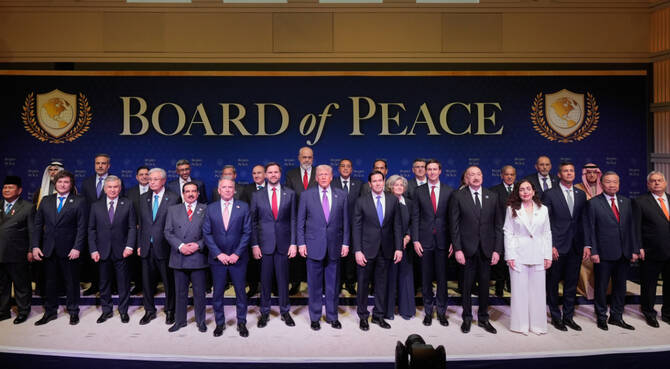
An official from the Board of Peace, created by U.S. President Donald Trump to help prepare for Gaza’s postwar transition, told AFP that planning was continuing even if negotiations failed to produce an agreement on Hamas’ disarmament.
The official said the Board’s strategy was based on preparing for the worst-case scenario, including plans for a pilot humanitarian zone in the southern city of Rafah that would move forward regardless of the outcome of political talks.
Among the proposals under discussion is the creation of an International Stabilization Force to help maintain security in Gaza during a transitional period. According to the Board of Peace official, Morocco, Kosovo, Albania and Kazakhstan are actively participating in the initiative.
The official said a logistical base near the Kerem Shalom crossing on the Israeli side of the border was close to completion and would initially accommodate about 500 troops before any deployment into Gaza. Preparations are also underway for a Palestinian police force, with roughly 20,000 applications received.
Diplomatic and security sources, however, told AFP that progress has largely stalled. One diplomatic source said police training had not yet begun and that Israel had rejected the current list of recruits after a vetting process, arguing that a proposed force of 5,000 officers would be too large.
Although a ceasefire has been in place since October 2025, violence continues across Gaza. Israel has carried out strikes that it says target violations of the truce by Hamas and other Palestinian armed groups.
Humanitarian challenges remain equally daunting. The United Nations estimates that rebuilding Gaza will require tens of billions of dollars and take years to complete, with shortages of construction materials and equipment continuing to hamper recovery efforts.
While international donors have pledged significant financial support, the Board of Peace said much of that funding has yet to be released. The Board is currently planning a pilot humanitarian zone in Rafah that would accommodate tens of thousands of vetted Palestinians.
Governance arrangements also remain unresolved. Hamas has announced its intention to transfer administrative responsibilities to the National Committee for the Administration of Gaza, a body established by the Board of Peace and composed of Palestinian technocrats responsible for managing civilian affairs during a transitional period.
However, Palestinian and diplomatic sources told AFP that the committee has not entered Gaza because Israel has prevented its members from doing so. Israel has maintained that replacing Hamas’ administrative structures does not address its longstanding demand that the group’s military capabilities be dismantled.
The future role of the Palestinian Authority remains another unresolved issue. Internationally recognized as the official Palestinian governing body, the Authority is expected by European officials to work alongside the transitional committee.
Several observers cautioned that any interim administration could find itself responsible for delivering public services while lacking authority over security forces and border crossings, leaving it dependent on international backing and vulnerable if Hamas retains all or part of its military infrastructure.


