Ancient Rock Art in Taif’s Al-Sail Al-Sagheer Brings Early Arabian Life Into Focus
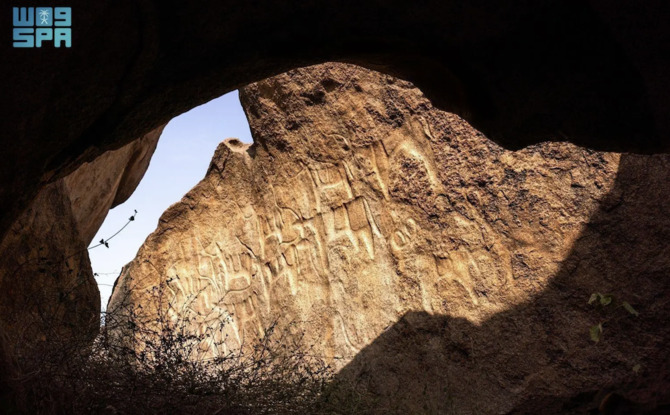
Riyadh – Ancient rock engravings carved into the mountain walls of Al-Sail Al-Sagheer in Taif governorate continue to captivate historians, researchers, and cultural observers with their quiet yet powerful storytelling.
These engravings offer a rare visual window into the lives of early communities that once traversed and settled across western Arabia, preserving moments of human experience across generations.
The markings stand as compelling evidence of sustained human presence in the region, reflecting how multiple civilizations interacted with the landscape over long periods of time.
Etched into stone surfaces shaped by nature, the rock art reveals scenes that speak of survival, movement, belief systems, and daily activities rooted in close harmony with the environment.
Researchers describe the site as a living archive, where each carving contributes to a broader narrative of environmental change, social organization, and economic adaptation.
The engravings suggest that Al-Sail Al-Sagheer functioned as a strategic corridor for ancient populations, connecting routes used for migration, trade, and seasonal settlement.
Its location offered access to natural resources, water sources, and protective rock formations, making it an attractive destination for both temporary and permanent habitation.
Historians note that such corridors played a critical role in shaping early Arabian societies, facilitating cultural exchange and continuity across vast landscapes.
The rock art also provides insight into how early inhabitants interpreted their surroundings, translating lived experience into enduring symbols carved directly into stone.
Animal figures, abstract forms, and symbolic markings highlight evolving relationships between humans, wildlife, and the land that sustained them.
Scholars emphasize that these engravings are not isolated artistic expressions but part of a wider network of archaeological sites that define Taif’s historical importance.
The governorate has increasingly gained recognition among heritage specialists for its rich concentration of sites that span different historical eras.
Experts describe the rock art as a cornerstone of national cultural heritage, representing a shared identity rooted in deep historical continuity.
Preserving these engravings is seen as essential to maintaining a tangible link between modern society and the lives of those who shaped the region thousands of years ago.
Cultural specialists stress that the protection of such sites supports broader efforts to safeguard heritage while promoting responsible cultural tourism.
The rock art of Al-Sail Al-Sagheer holds significant educational value, offering opportunities for research, academic study, and public engagement.
By documenting these carvings through scientific methods, researchers can ensure their stories are preserved for future generations.
Such documentation also enhances understanding of how early Arabian communities responded creatively to environmental challenges and shifting social realities.
The engravings reinforce the idea that Arabia was not a peripheral landscape but a dynamic center of human movement and cultural development.
Preservation initiatives align closely with national strategies focused on celebrating heritage as a source of pride, learning, and sustainable development.
Authorities and scholars alike highlight the need for protective measures to prevent natural erosion, vandalism, or unregulated access from threatening the site.
Awareness campaigns are seen as equally important, helping local communities and visitors recognize the value of safeguarding these ancient expressions.
The rock art also plays a role in strengthening cultural tourism, attracting visitors interested in history, archaeology, and authentic cultural experiences.
Such tourism supports local economies while encouraging respectful engagement with heritage landscapes.
The engravings remind observers that human creativity and storytelling long predate written language.
They demonstrate how early societies used visual symbols to record identity, memory, and connection to place.
In an era of rapid modernization, these ancient carvings offer a grounding perspective on humanity’s enduring relationship with land and culture.
They invite reflection on how the past continues to inform present identities and future aspirations.
Taif’s Al-Sail Al-Sagheer stands today not only as an archaeological site but as a bridge between eras.
Its rock art quietly affirms that the stories of early Arabian life remain etched into the landscape, waiting to be understood and preserved.