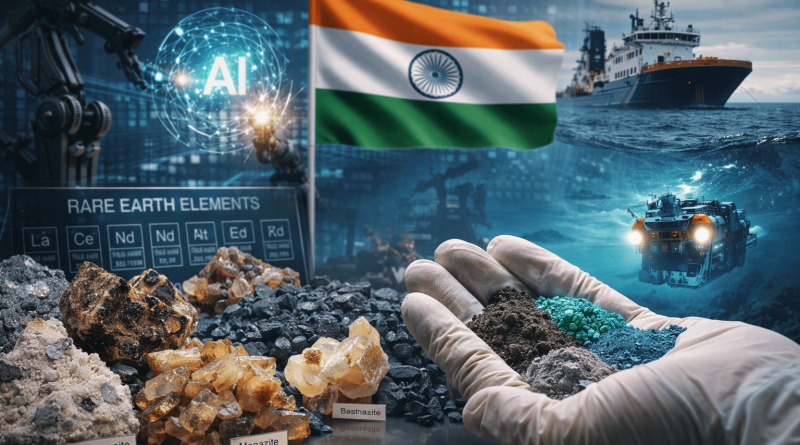
OPINION: How Rare Earths Can Power India’s Strategic Autonomy

Collaborative research funding and institutional support would ensure that innovation translates into deployable solutions.
Rare earths have quietly become one of the most consequential fault lines in the global economy. The latest move by the United States to create a critical mineral trading bloc to counter China’s dominance over rare earth supply chains reflects a growing recognition that access to rare earth elements (REEs) now shapes economic competitiveness, technological power, and strategic autonomy.
Nearly four decades after former Chinese Premier Deng Xiaoping remarked “if the Middle East has oil, China has rare earth elements,” the observation has aged with unsettling accuracy.
As the global economy pivots toward electrification, automation, and data-intensive systems, demand for RREs is no longer driven only by hardware. Artificial intelligence (AI) has emerged as a major multiplier of rare earth demand, as the development and deployment of AI systems depend on materials whose supply chains are fragile and geographically concentrated.
Despite holding some of the world’s largest rare-earth reserves, India remains marginal in extraction and processing—leaving it exposed to China’s dominance over critical mineral supply chains that underpin modern defense, technology, and clean energy systems. Translating reserves into genuine strategic autonomy will require India to move beyond regulatory inertia and invest across the value chain, from mining to processing and recycling.
Lessons from China’s Rare Earth Experiment
Paradoxically, rare earths are not geologically scarce. They are moderately abundant and well distributed across the Earth’s crust, including in India, which holds the world’s third-largest known reserves. What makes them “rare” is the absence of economically viable concentrations and the technological, environmental, and regulatory hurdles associated with extraction and processing.
At present, China dominates nearly every node of the REE supply chain—accounting for roughly 60 percent of global mining, and more than 80 percent of global processing. This dominance reflects decades of coordinated industrial policy, control over upstream and downstream processes, and a deliberate effort to retain technological know-how by restricting foreign participation.
China has demonstrated its willingness to weaponize this dominance time and again, from export restrictions in 2010 to trade disputes with Japan and the United States. This reveals the geopolitical risks embedded in concentrated supply chains and has triggered renewed global concern and efforts to diversify sources — from Japan’s recent deep-sea sediment retrieval to the latest effort by the US to form a free trade zone.
Yet even as countries race to secure alternative supplies, the processing and manufacturing choke points remain firmly entrenched because most refining capacity is still clustered in China. In an era where AI systems increasingly determine economic and military advantage, such concentration poses not just a supply risk but a strategic vulnerability.
Why India Matters
From India’s perspective, rare earths sit at the intersection of industrial policy, strategic autonomy, and technological sovereignty. India holds nearly six percent of global known rare earth reserves, almost thrice as much as the United States, yet accounts for barely one percent of global production. The Mines and Minerals (Development and Regulation) Amendment Act, 2023, launched by India’s Ministry of Mines, marked a belated recognition of this imbalance by ending Indian Rare Earths Limited’s long-standing monopoly and opening the sector to greater participation.
While this is a step in the right direction, it does little on its own to address the deeper constraints that have historically sidelined REEs in India’s mining strategy. As a result, rare earth extraction has continued to be treated largely as a secondary by-product rather than a deliberate, strategic industrial objective. This underscores the need for a more comprehensive policy push that goes beyond regulatory liberalization.
At the same time, India and the United States share a growing dependence on rare-earth—intensive technological demands and a common interest in reducing over-reliance on China—an objective neither can achieve independently. For both nations, this shared objective offers a new frontier on alignment and cooperation: using partnership to accelerate REE capacity, close technological gaps, and integrate into resilient, non-coercive supply chains.
Policy Pathways for Cooperation
Four coordinated actions can turn India’s rare earth interests from a source of strategic vulnerability into a foundation for long-term autonomy in critical technologies, while putting it on a path to global leadership across the supply chain.
Facilitating Indian Production Capacity
China’s share of global REE mining has declined over the last decade, largely because countries such as the United States, Australia, and Japan actively coordinated policy, finance, and technology to revive domestic mining. India has not yet undertaken a comparable effort. While recent regulatory changes indicate a willingness to move beyond legacy arrangements, they stop short of enabling large-scale production.
Expanding the remit of existing US–India working groups to explicitly include the commercialization of REE production in India is therefore essential. Encouraging private sector participation can help translate regulatory opening into capacity, while access to American extraction technologies and targeted viability gap funding could make upstream investments commercially feasible.
Building Downstream Processing Capabilities At Scale
If rare earths are to modern technology what salt is to food, then extracting them from mineral deposits is like extracting salt from freshwater – technically complex, energy-intensive, and environmentally sensitive. Despite its reserves, India has only recently developed limited processing capacity for rare earth oxides. High capital costs, energy requirements, and technological barriers continue to deter private investment.
A formal bilateral framework for jointly funded oxide-processing ventures, combined with cooperation on AI-enabled mineral processing, separation technologies, and automation, could significantly reduce costs and improve efficiency.
Exploring Maritime and Deep-Sea Resources
Terrestrial REE deposits remain geographically concentrated. Diversification, therefore, requires looking beyond land. The deep seabed – among the least explored regions on Earth – offers potential mineral resources that could reshape supply dynamics. India’s capabilities in oceanography and seabed exploration, combined with emerging AI-driven mapping and sensing technologies, position it well for leadership in this domain.
Expanding existing multilateral frameworks to include cooperation on responsible, ethical, and sustainable deep-sea mineral exploration would align economic objectives with environmental stewardship.
Investing in Recycling and Alternatives
Known REE sources are finite, and primary extraction alone cannot meet long-term demand. Recycling and substitution technologies therefore become indispensable.
At present, rare earth recycling remains economically unattractive due to high costs, limited infrastructure, and weak regulatory incentives. Investment in recycling technologies, material recovery, and alternative materials – supported by coordinated regulatory frameworks and workforce development – can help bridge this gap. Collaborative research funding and institutional support would ensure that innovation translates into deployable solutions.
As India looks toward 2047 and the centenary of its independence, the next two decades will be defined by the choices it makes today on critical technologies and industrial capacity.
Rare earths will shape the trajectory of its AI-driven growth, strategic autonomy, and technological sovereignty. Leveraging partnerships to strengthen domestic production, processing, and innovation can move India from a passive holder of reserves to an active shaper of supply chains.
In this context, cooperation with the United States and within the emerging free trade zone for critical minerals, offers a practical pathway—not just to reduce dependence on China, but to build resilient, responsible, and future-oriented technology ecosystems.
Disclaimer: Views expressed by writers in this section are their own and do not reflect Milli Chronicle’s point-of-view.