Beyond the Visible: The Search for Dark Matter in the Universe
For centuries, the night sky appeared to humanity as a vast but understandable structure of stars and planets governed by physical laws.
Modern astronomy, however, has revealed a startling truth: the majority of the universe is invisible. The stars that illuminate galaxies represent only a small fraction of cosmic matter.
The rest is believed to consist largely of a mysterious substance known as Dark Matter.The idea of dark matter emerged in the early twentieth century when astronomers studying galaxy clusters noticed something unusual.
The visible mass of galaxies stars, gas and dust could not account for the gravitational forces observed within these clusters. Galaxies were moving far faster than expected.
Without additional gravitational influence, such systems should have dispersed long ago. The logical conclusion was that unseen matter must be exerting gravitational pull.
Further evidence appeared when scientists measured how stars orbit inside galaxies. Observations showed that stars on the outer edges of galaxies moved almost as quickly as those near the center.
According to Newtonian physics, objects farther from the center should orbit more slowly.The unexpected speed suggested that galaxies were embedded in enormous halos of invisible mass. This unseen material became known as dark matter.
Despite the name, dark matter is not simply ordinary matter hidden in shadows. It does not emit, absorb or reflect light. Telescopes cannot observe it directly. Instead, scientists detect its presence through its gravitational influence on visible objects.
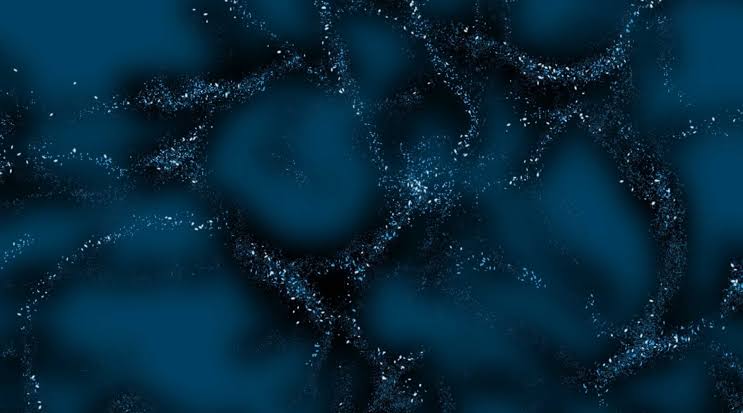
Evidence for dark matter also comes from the large-scale structure of the universe. Galaxies are not distributed randomly across space. Instead they form vast filaments and clusters, creating what astronomers describe as a cosmic web.
Computer simulations suggest that such structures could not have formed without large amounts of unseen matter guiding gravitational collapse in the early universe. Observations of the Cosmic Microwave Background the faint radiation left over from the universe’s earliest moments also support this conclusion.
Current cosmological models estimate that dark matter accounts for roughly 27 percent of the universe’s total mass and energy. Ordinary matter the atoms forming stars, planets and living organisms represents only about 5 percent.The nature of dark matter remains one of the greatest unsolved questions in physics.
Several theoretical particles have been proposed to explain it. Among the most widely discussed are weakly interacting massive particles, commonly called WIMPs, and hypothetical particles known as axions.
Scientists around the world are conducting experiments designed to detect these elusive particles. Some detectors are located deep underground, shielded from cosmic radiation, where researchers hope to observe rare interactions between dark matter particles and ordinary matter.
Particle accelerators such as the Large Hadron Collider also search for evidence of new particles that might correspond to dark matter theories. By recreating extremely high-energy collisions, physicists attempt to identify particles that standard models cannot explain.
Astronomers also use gravitational lensing a phenomenon predicted by the Theory of Relativity to map dark matter in the universe. Massive clusters of galaxies bend light traveling through space, revealing the presence of invisible mass.
These observations allow scientists to create detailed maps of dark matter distribution across cosmic structures. In many cases, the invisible matter forms the underlying framework upon which galaxies are built.The search for dark matter reflects a broader transformation in scientific thinking.
For much of history, humans assumed that the visible universe represented the majority of reality. Modern cosmology suggests the opposite.Most of the cosmos consists of substances and forces that cannot be directly observed. Dark matter and dark energy together dominate the universe, shaping its evolution on the largest scales.
Yet this mystery also highlights the strength of scientific inquiry. Even phenomena that cannot be seen directly can be understood through careful observation, mathematics and experimentation.The invisible universe therefore remains one of the most exciting frontiers of modern science.
Each new observation brings researchers closer to answering one of the deepest questions humanity has ever asked: what is the universe truly made of?