Mali Junta Chief Vows Crackdown After Coordinated Insurgent Assault
Bamako– Mali’s military leader Assimi Goita said on Tuesday that the security situation was under control and pledged to “neutralize” insurgents responsible for coordinated attacks over the weekend, in his first public appearance since militants struck key military and strategic sites across the country.
Goita’s televised address came after West Africa’s Al-Qaeda affiliate Jama’at Nusrat Al-Islam wal-Muslimin (JNIM) and a Tuareg-led separatist alliance launched attacks on Mali’s main army base and the area near Bamako’s airport on Saturday, while also forcing Russian-backed government forces out of the strategic northern town of Kidal.
The offensive marked one of the most significant coordinated assaults against Mali’s military government in recent years, raising concerns over a broader territorial shift in the country’s vast northern desert and the growing operational reach of armed groups active across the Sahel.Mali’s Defense Minister Sadio Camara was killed in the attacks, dealing a major blow to the ruling junta.
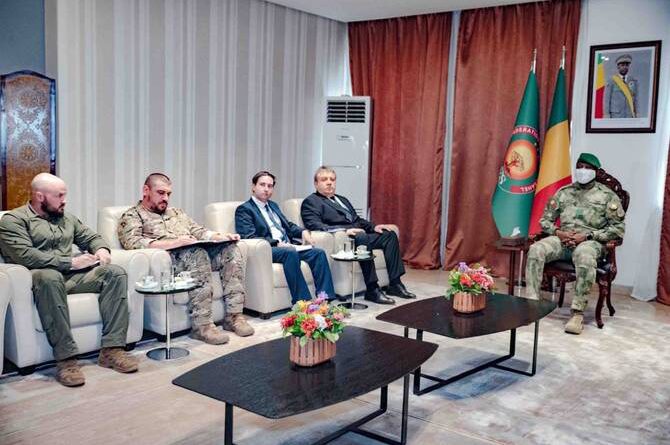
Goita had not been seen publicly until Tuesday afternoon, when his office released photographs of him meeting Russian Ambassador Igor Gromyko at the presidential palace in Bamako.
According to a statement from Goita’s office, the two discussed “the current situation and the strong partnership between Bamako and Moscow,” while Gromyko reaffirmed Russia’s commitment to supporting Mali in its fight against what the government described as international terrorism.
Goita also visited a hospital treating those wounded in the attacks and offered condolences to Camara’s family before addressing the nation on state television.“The situation is under control,” Goita said, adding that military operations would continue until the “complete neutralization of the groups involved.”
The scale of Saturday’s attacks demonstrated an unusual level of coordination between insurgent factions with differing political and ideological objectives, highlighting the mounting pressure on Mali’s armed forces despite years of military cooperation with Russian security partners.
In a video message circulated on Tuesday, JNIM spokesperson Bina Diarra described the attacks as retaliation for drone strikes and other operations carried out by Malian forces and threatened to impose a siege on Bamako.“As of today, Bamako is closed off from all sides,” he said.JNIM had previously imposed a fuel blockade on the capital last year, though restrictions had eased before the latest attacks.
Russia’s Defense Ministry said on Tuesday that insurgents were regrouping after Russian forces helped repel what it described as a coup attempt, preventing militants from capturing key state facilities including the presidential palace.“The enemy has not abandoned its aggressive intentions and is currently regrouping,” the ministry said, adding that Russian forces were conducting reconnaissance operations to destroy insurgent camps and were prepared to repel further attacks.
Moscow’s response is being closely watched as Russia seeks to expand its security role across Africa while its military remains heavily engaged in Ukraine.Mali deepened military ties with Russia after expelling French troops and United Nations peacekeepers following coups in 2020 and 2021.
In the northeast, fighters linked to Islamic State in the Sahel Province (ISSP) entered the town of Menaka near the Niger border, according to five sources cited by Reuters, including residents, security analysts and an official from the Azawad Liberation Front.
The sources said ISSP fighters established checkpoints in parts of the town while Malian troops withdrew to a nearby military camp. No direct clashes were reported, and residents said civilians continued moving through the city despite the presence of militants.
ISSP did not participate in Saturday’s coordinated attacks and has long been a rival of JNIM. Since clashes between the two groups began in 2019, they have fought hundreds of battles that have killed more than 2,100 people, according to data from the Armed Conflict Location & Event Data project.