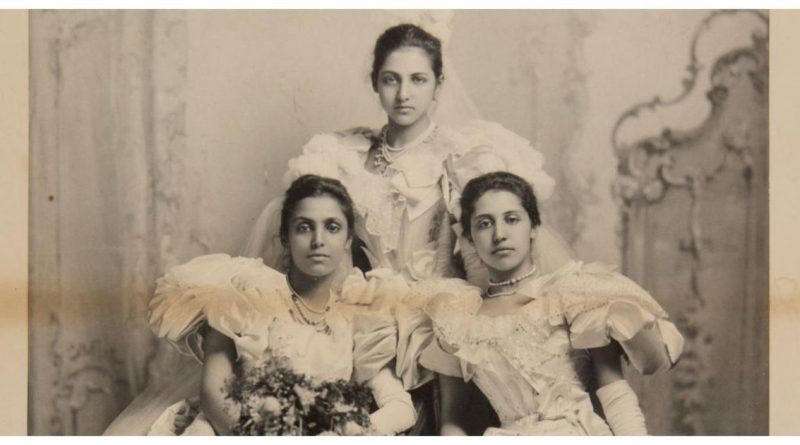
London exhibition examines lives of Duleep Singh princesses amid renewed focus on colonial histories
“They were different from everyone else.”
A new exhibition at Kensington Palace is drawing attention to the lives of the daughters of Maharaja Duleep Singh, presenting their trajectories as part of a broader reassessment of how colonial-era histories are interpreted in British institutions.
Titled “The Last Princesses of the Punjab,” the exhibition brings together 117 artefacts to document the lives of Princesses Sophia, Bamba and Catherine Duleep Singh, whose experiences spanned Britain, India, Europe and the United States across the late 19th and early 20th centuries.
The display situates their biographies within the political and social transformations triggered by the annexation of Punjab in 1849, when the British Empire absorbed the Sikh kingdom established by Maharaja Ranjit Singh.The exhibition is hosted by Historic Royal Palaces, which oversees several royal residences including the Tower of London and Hampton Court Palace.
Curators said the project reflects a shift toward examining the lived experiences of individuals shaped by imperial systems, rather than focusing solely on imperial artefacts or state narratives.The narrative begins with the early life of Duleep Singh, who became ruler of the Sikh empire as a child before being deposed following the Anglo-Sikh Wars.
After the annexation, he was separated from his mother and brought to Britain in 1854 under the guardianship of a Scottish couple. In London, he developed close ties with the British monarchy, including Queen Victoria, and became a prominent figure in elite society.In 1864, he married Bamba Müller, the daughter of a German businessman and an Abyssinian woman, in Egypt.
The couple later settled in Suffolk, where they raised six children, including the three daughters who are the focus of the exhibition. According to curatorial material, the children were baptised into the Church of England and raised within British aristocratic norms, including formal education and participation in elite social circles.
During their upbringing, the daughters were not permitted to travel to India, reflecting concerns within British authorities that the presence of the deposed royal family could encourage anti-colonial sentiment. After Duleep Singh left Britain in 1886 and his first wife died shortly thereafter, the daughters became wards of the India Office, effectively placing them under official supervision.
The exhibition traces how the three sisters diverged in adulthood. Princess Bamba pursued medical studies in Chicago in 1901 before relocating to Lahore in 1903, where she lived for more than five decades. Princess Sophia became involved in political activism in Britain, including participation in the suffrage movement.
Princess Catherine spent much of her life in Germany before returning to Britain during the Second World War.According to historian Mishka Sinha, who serves as curator for inclusive history at Historic Royal Palaces, the sisters’ backgrounds placed them in what she described as a “multiple marginal” position, shaped by their mixed heritage, gender and colonial status.
She said this intersection contributed to their varied engagements with political and social movements of the period.Archival material in the exhibition includes a 1911 census document annotated by Sophia with the words “No Vote, No Census,” reflecting her involvement in the Women’s Social and Political Union, a leading organization in Britain’s suffrage campaign.
Records also indicate she worked as a nurse for Sikh soldiers during the First World War and resisted tax payments as part of protest actions.Catherine’s later life is documented through materials linked to her residence in Kassel, Germany, and her subsequent return to Britain. During the Second World War, she sheltered Jewish refugees in her Buckinghamshire home.
Among the artefacts displayed is the passport of a child refugee, as well as a piece of jewellery Catherine later gifted to her.The exhibition also addresses Princess Bamba’s long residence in Lahore, including her experiences during the Partition of India in 1947.
Curators incorporated this period to highlight the continued impact of colonial-era legacies into the mid-20th century, particularly in regions affected by large-scale population displacement.Objects displayed include personal belongings, correspondence, textiles and musical scores, including a copy of Die Meistersinger owned by the family.
Curator Polly Putnam said the selection was designed to support each historical claim with material evidence, emphasizing artefacts as primary sources rather than decorative additions.The exhibition also incorporates oral history through recorded testimonies.
One such account comes from Peter Barrall, who as a child encountered Princesses Sophia and Bamba during the Second World War after being evacuated from London to their estate in Norfolk. Barrall recalled that the sisters maintained a formal distance but occasionally interacted with local children under strict etiquette.
The curatorial team worked with collectors and historians, including Peter Bance, who has assembled a large private archive related to Duleep Singh and his descendants.
According to historian Tony Ballantyne, the family continues to hold symbolic significance for the Sikh diaspora, where Duleep Singh is often regarded as a figure linked to both religious identity and political history.Curators said the exhibition also reflects evolving institutional approaches to colonial collections.
In one instance, textile items previously catalogued as saris were reidentified as dupattas following further research, illustrating efforts to correct earlier classifications.The exhibition runs through November and forms part of a broader trend among European institutions to reassess colonial-era narratives through biographical and community-linked perspectives, drawing on archival research, material culture and oral testimony.