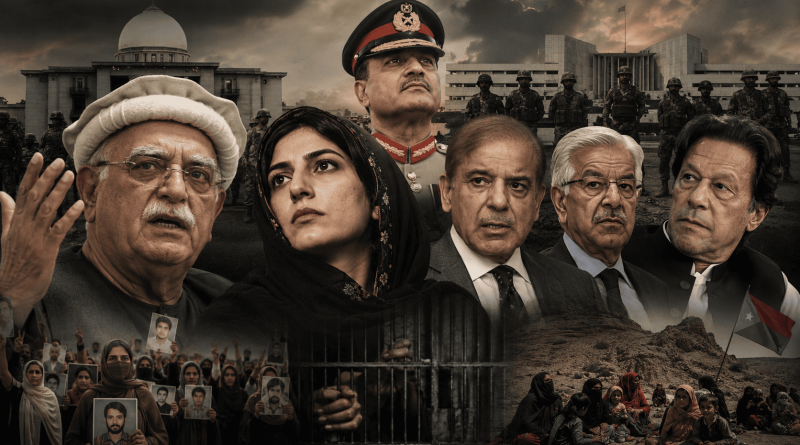
From Achakzai to Mahrang: Pakistan’s War on Democratic Dissent

If anything, the present nexus between the military establishment and the toothless civilian leadership has shown that it is difficult to have a fair space for criticism and dissent in Pakistan.
In yet another flummoxing display, Pakistan has charged the opposition leader in the National Assembly with treason. Mehmood Khan Achakzai, Chairman of the Pashtunkhwa Milli Awami Party (PkMAP), has been booked and charged with treason for his remarks at a public meeting in Balochistan. Achakzai is the president of Tehreek Tahaffuz Ayeen-i-Pakistan (TTAP), a multi-party opposition alliance formed to protect the Constitution of Pakistan, which, according to the opposition, is under attack from the military establishment, with the support of the government.
Although a long practice in the country, using the draconian law to silence critics of the military establishment/government has picked up in recent years. One reason for that is the nature of the present ruling administration.
It is interesting to see that the scope of these laws has expanded; now the political opponents of the existing “hybrid model” of government in Pakistan, as Defence Minister Khawaja Asif calls it, have borne the brunt of the sedition laws for their criticism of the government, or the hybrid regime, to put it in its truest description. The civilian leadership is forced to mitigate the adverse effects of the model simply because it cannot be in government or run functions if it were to break ties with the military establishment. That being the case, the civilian part of the model is subservient to the military establishment. How can that be called even a “hybrid model”?
The civilian leaders act as intermediaries, while the military establishment pulls the strings on every decision. No wonder that in the last couple of years, Prime Minister Shehbaz Sharif, Defence Minister Khawaja Asif, and others have been currying favour with the country’s security forces, even on the economy. Prime Minister Sharif, known for his unhinged use of praise to extract favours from powerful personnel, went beyond even his own previous injudicious acts and said on an occasion recently that “History will always remember the wise and courageous leadership of the field marshal (Asim Munir) in golden words.”
Such flattering words from the Prime Minister tell a lot about the nature of the current model of governance in Pakistan: the civilian leaders will act on behalf of or for the military generals, and critics will bear the brunt.
Achakzai’s case is not the only one. On a similar pattern, in yet another high-profile case, former Prime Minister Imran Khan was charged with treason for a rather bizarre accusation. Several activists and political opponents have been sent to jail after being charged with the draconian law.
All these cases are nothing but a mockery of such a serious penal law. While Imran Khan was accused of wrongfully dissolving parliament in 2022, Achakzai’s case is more interesting: he is charged with treason because he questioned the law and order situation in Balochistan and said that the government had failed to provide security to the people. There is no shortage of reports, even statements from the military establishment and the government on the situation in Balochistan that would mean the same, but it coming from the opposition leader is chargeable with the harshest possible penal code in the country, underscoring the strict policy of the current administration towards its opponents.
More importantly, the case against the Opposition Leader in the National Assembly exposes the nature of politics in Pakistan. Essentially, the crux of the issue is that the military establishment is domineering in the present ruling political system, and any criticism of an issue points towards the failures of the military establishment. And given the stakes of Field Marshal Asim Munir in the system, the Army is unlikely to tolerate that. Therefore, conformity is sought in every case, at every possible cost.
It also shows that Pakistan’s perennial political crisis has taken a life of its own. There is no sign of it getting resolved. The Pakistani State has taken a clarion call: everyone must conform to the current administration, i.e., the military establishment, the deep state and its coterie in the civilian power circles.
Historically, the military has dominated the country’s politics. Its domestic and foreign policies have been shaped by the generals. Even domestically, it is well documented that the military has “groomed” and “appointed” leaders in the country.
In politics, it is said that nation and state function as synonyms; in Pakistan, the military establishment and the state function as synonyms. So, any criticism against the military means the state is criticised. Such criticism therefore begets a strong punitive and legal response, including the charges of sedition.
The story does not end here. Given that the military establishment is deeply involved in the government, any criticism, therefore, against the government is interpreted as a criticism against the military, and thus against the state. And there is a long list of such cases in Pakistan. Some of these include the cases of Baloch and Pashtun activists. In such cases, the people who have questioned the government policies towards Balochistan and Khyber-Pakhtunkhwa (KP) have been accused of treason and put behind bars.
Almost the entire leadership of Baloch Yekjehti Committee (BYC), a non-violent Baloch organisation mainly comprised of the Baloch whose relatives have been victims of enforced disappearances, is in jail. So is the former member of the National Assembly and Pashtun activist, Ali Wazir. Wazir has been behind bars for a long time on treason charges for questioning the policy of the military operations and their impact on the common Pashtun in KP. Ali Wazir has spent a good share of his life in jail. He was arrested a few hours after he was released on bail on 26 March. The cases against Wazir are various sedition cases.
Likewise, Mahrang Baloch, a Baloch and doctor by profession, along with others, is facing multiple cases of sedition. Even if she gets some relief or bail in one case, other cases are invoked to keep her behind bars. The same method is used against the people who support or defend activists in the courts of the country. Imaan Mazari and Hadi Chattha, advocates who are fighting cases of several victims of state violence, have been booked, charged and sentenced to 17 years of imprisonment for social media posts that were critical of the country’s security institutions.
If anything, the present nexus between the military establishment and the toothless civilian leadership has shown that it is difficult to have a fair space for criticism and dissent in Pakistan. Now, since the military establishment has increasingly taken control of the country into its hands, any civilian leadership or government is symbolic. Naturally, any criticism directed at the government will be seen as criticism of the military establishment. Therefore, in all likelihood, draconian laws like treason and others will be employed more to frighten and curb dissenting voices in Pakistan.