Far-Right Challenger Vannacci Tests Meloni’s Grip on Italy’s Conservative Bloc
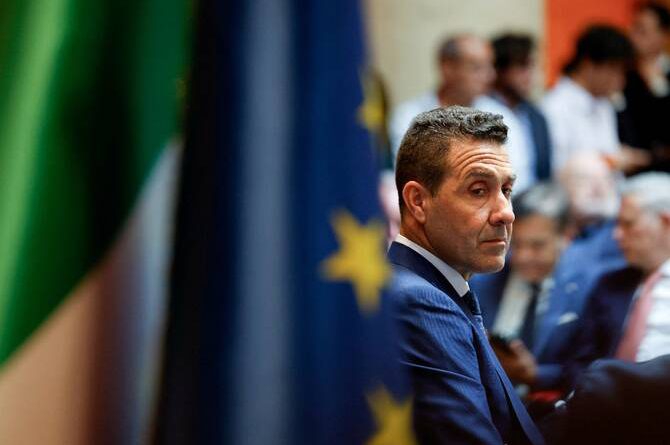
Rome– Italian Prime Minister Giorgia Meloni is facing a growing political challenge from former army general Roberto Vannacci, whose newly formed far-right movement is gaining support and threatening to fragment Italy’s governing conservative coalition ahead of elections expected next year.
Just four months after leaving the League party, one of Meloni’s coalition partners, Vannacci says his new party, Futuro Nazionale, has attracted nearly 100,000 paying members and is polling at around 4% nationally, a level that could prove influential in a closely contested election.
The rise of the former paratrooper presents a strategic dilemma for Meloni. Embracing Vannacci could alienate moderate voters who have supported her efforts to reposition her government as a mainstream conservative force, while ignoring him risks allowing a rival on the right to gain further momentum.
Futuro Nazionale is due to be formally launched this weekend and is positioning itself as a nationalist alternative to the governing coalition, accusing Meloni and her allies of abandoning core right-wing principles.
“We represent that right which is not faded, not wavering, not fearful,” Vannacci said earlier this year, arguing that the government had softened its positions on European integration, migration and law-and-order issues.
The 57-year-old first gained national prominence after publishing a controversial book advocating traditional values while criticizing LGBTQ rights, migration and feminist movements. The publication led to criticism from Italy’s defense establishment and his suspension from active military service.
League leader and Deputy Prime Minister Matteo Salvini later brought Vannacci into the party, helping him secure election to the European Parliament in 2024. However, the alliance proved short-lived, with Vannacci leaving in February to establish his own movement.
Political analysts say his emergence is likely to intensify competition within Italy’s right-wing electorate.
Sofia Ventura, a political science professor at the University of Bologna, said Salvini’s decision to promote Vannacci had ultimately strengthened a future rival and could pressure both Salvini and Meloni to adopt tougher positions to retain conservative voters.
An SWG opinion poll published on Friday placed Futuro Nazionale at 4.6%, narrowing the gap with the League, which stood at 5.8%. The same survey showed a loose alliance of center-left parties marginally ahead of the governing coalition.
Vannacci has aligned himself in the European Parliament with nationalist and Eurosceptic forces, including Germany’s Alternative for Germany (AfD), a stance that has complicated prospects for cooperation with more moderate coalition partners such as Forza Italia.
Foreign Minister Antonio Tajani, leader of Forza Italia, said he had no contact with Vannacci, although he did not rule out future discussions before the next election.
Since taking office in 2022, Meloni has sought to transform her Brothers of Italy party from a hard-right opposition movement into a governing force accepted by European and transatlantic partners. Her support for Ukraine and efforts to maintain constructive relations with Brussels have strengthened her international standing.
Vannacci’s platform challenges that approach. He combines criticism of the European Union with skepticism about Western military support for Ukraine and has argued against what he describes as unconditional backing for Kyiv.
His movement has already attracted eight lawmakers from coalition parties, highlighting concerns within government ranks that his influence could grow further.
Whether Futuro Nazionale develops into a lasting political force may depend on its ability to build a broader organization beyond Vannacci’s personal popularity. For now, however, his rise has added a new source of uncertainty to Italy’s increasingly competitive political landscape.