
Xi seeks to revive North Korea alliance as Beijing reasserts regional influence
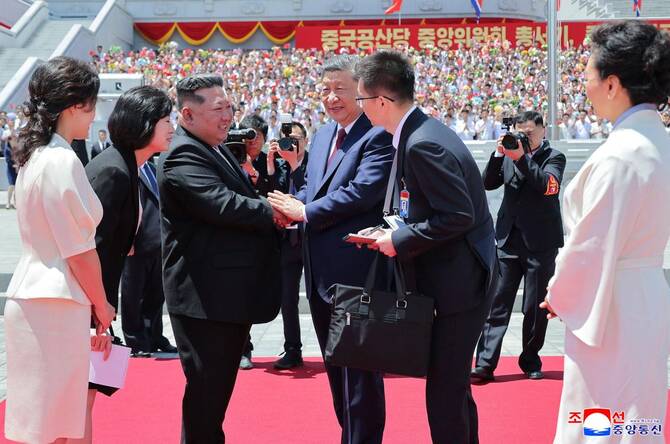
Seoul-Chinese President Xi Jinping returned to Beijing on Tuesday after a closely watched visit to North Korea, where he and leader Kim Jong Un pledged to deepen bilateral cooperation and strengthen a relationship that analysts view as increasingly important to both countries’ strategic interests.
Xi’s two-day trip to Pyongyang, his first in seven years, underscored efforts by Beijing and Pyongyang to revitalize a traditional alliance that has faced new challenges amid North Korea’s growing ties with Russia and shifting regional geopolitical dynamics.
During a summit on Monday, Xi expressed China’s willingness to expand cooperation in areas including trade, agriculture, construction and technology, according to Chinese and North Korean state media. Kim, in turn, described maintaining ties with China as a top strategic priority for his government.
The visit included a series of highly symbolic events aimed at highlighting historical bonds between the two neighbors. Xi and Kim visited a monument commemorating Chinese soldiers who fought alongside North Korean forces during the 1950-53 Korean War and emphasized the importance of preserving the legacy of bilateral cooperation and resistance against foreign pressure.
The two leaders also toured a Workers’ Party training institution and participated in a tree-planting ceremony intended to symbolize the long-term development of relations between their countries.
The summit came less than a year after Xi and Kim met in Beijing and reflected a broader effort by both governments to maintain strategic coordination amid growing uncertainty in Northeast Asia.
State media reports emphasized commitments to expand economic and political cooperation and highlighted North Korea’s support for China’s position on Taiwan under Beijing’s “one-China” policy.
Notably absent from official accounts of the talks was any public discussion of North Korea’s nuclear weapons program, a longstanding source of regional tension and a central issue in international diplomacy involving Pyongyang.
The omission has drawn attention among regional analysts. Some experts view the absence of references to denuclearization as a diplomatic advantage for North Korea, which has increasingly sought recognition as a nuclear-armed state while pressing for sanctions relief and greater international acceptance.
Ban Kil Joo, an assistant professor at the Korea National Diplomatic Academy in Seoul, said the lack of discussion about denuclearization could be interpreted as China leaving room for broader acceptance of North Korea’s current strategic status rather than actively challenging it.
Analysts also see the visit as part of China’s effort to restore its influence over North Korea after Pyongyang deepened military and political cooperation with Russia in recent years. North Korea has strengthened ties with Moscow through support for Russian military efforts and expanded strategic cooperation, raising questions about Beijing’s traditional role as Pyongyang’s primary external partner.
Kim Gyubeom, an analyst at the Institute for National Security Strategy in Seoul, said China appears to be pursuing a pragmatic approach that maintains communication and influence without applying significant pressure on North Korea, while prioritizing regional stability.
For Beijing, stronger ties with Pyongyang may also provide additional diplomatic leverage in its broader relationship with the United States. Analysts note that renewed Chinese influence over North Korea could become a factor in future dealings between Xi and U.S. President Donald Trump, who has repeatedly indicated interest in restarting diplomacy with Kim.
The visit highlighted a convergence of interests between Beijing and Pyongyang as both governments navigate an increasingly complex regional environment marked by strategic competition, security concerns and shifting alliances across East Asia.


