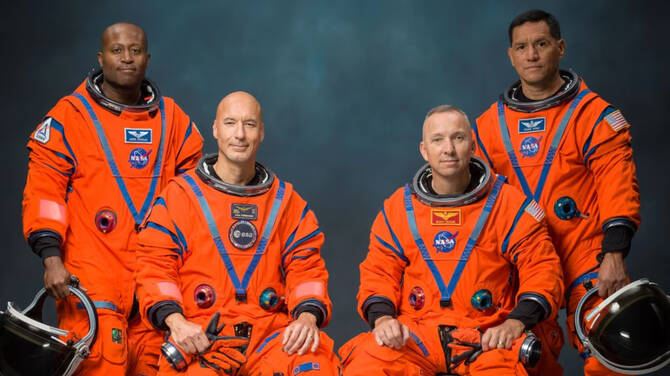
NASA Names Artemis III Crew as Moon Mission Push Accelerates Toward 2027
New York-NASA on Tuesday announced the astronaut crew for its Artemis III mission, marking a key step in the US space agency’s effort to return humans to the Moon and test technologies for future lunar exploration.
The four-member crew NASA astronauts Randy Bresnik, Frank Rubio and Andre Douglas, alongside European Space Agency astronaut Luca Parmitano will not land on the lunar surface but will conduct orbital operations and technical demonstrations designed to support future Moon landings.
The mission will focus on testing spacecraft docking procedures involving the Orion capsule and two separate lunar landers, a critical capability for upcoming deep space operations under NASA’s Artemis program.
NASA said the Artemis III mission builds on the success of Artemis II, which recently completed a record-breaking lunar flyby that surpassed the distance benchmark set by Apollo 13.
“To the Artemis III crew, we wish you Godspeed on the journey ahead,” NASA Administrator Jared Isaacman said during the announcement.
Mission specialist Andre Douglas said the selection marked an emotional milestone, describing his reaction as overwhelming, while commander Randy Bresnik emphasized the crew’s readiness to undertake the mission.
NASA’s Artemis program aims to return astronauts to the Moon for the first time since the Apollo era of the 1970s. The agency has also adjusted its timeline to accelerate preparations for a future landing, with a crewed lunar surface mission now targeted for 2028.
The program relies heavily on commercial partnerships, with SpaceX and Blue Origin competing to develop lunar landers. NASA officials said recent setbacks, including a Blue Origin rocket failure during a ground test in Florida, are being treated as learning opportunities, with confidence that development timelines remain on track.
NASA officials also said the broader Artemis initiative is intended to lay the groundwork for a sustained lunar presence, including the potential development of a future Moon base that could support eventual human missions to Mars.