India’s AI Trainers Teach Robots the Skills That May Replace Human Labor
Karur-Thousands of Indian workers are being paid to record everyday activities ranging from cooking and folding clothes to factory tasks, providing the data needed to train a new generation of artificial intelligence-powered robots as demand for humanoid automation accelerates globally.
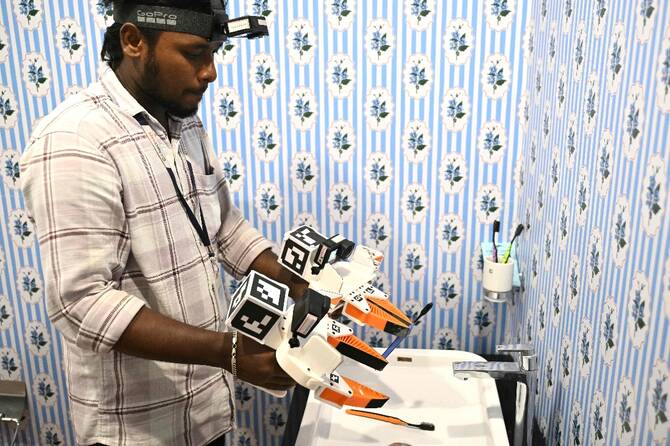
The emerging industry centers on collecting so-called “egocentric data” — first-person recordings captured through head-mounted cameras, smart glasses and motion sensors that allow AI systems to learn how humans interact with physical environments.
In Chennai, 25-year-old homemaker Nagireddy Sriramyachandra spends part of her day filming routine household chores, including food preparation, for AI data company Objectways.
She earns about 250 rupees ($3) an hour for the recordings, which are uploaded through a specialized application and used to train robotic systems.
Developers believe that exposing AI models to large volumes of human behavioral data will help robots perform real-world tasks more effectively, particularly in domestic and industrial settings where navigation and object manipulation remain significant technological challenges.
Objectways, which operates in India and the United States and works with machine-learning platform Amazon SageMaker, collects videos requested by corporate clients seeking to train robotics systems for activities such as folding clothes, preparing beverages and performing basic kitchen tasks.
The business reflects growing investor interest in humanoid robotics. Morgan Stanley has projected that more than one billion humanoid robots could be in operation worldwide by 2050, primarily in commercial and industrial applications.
Objectways Chief Executive Ravi Shankar said automation would eventually assume responsibility for some routine jobs, allowing workers to focus on more advanced activities.
The company’s operations extend beyond homes. At a textile factory in Tamil Nadu’s Karur district, workers wearing smart glasses and head-mounted cameras record manufacturing processes while carrying out routine production work.
India has increasingly positioned itself as a global center for AI data collection, annotation and processing services, leveraging its large labor force and established technology sector.
Aditi Surie, a digital labor researcher at the Indian Institute for Human Settlements in Bengaluru, said demand for data collection services linked to AI development is likely to expand as companies seek increasingly sophisticated training datasets.
The rise of such work has also intensified debate over automation’s impact on employment in a country where informal labor remains a major component of the economy.
Government policy think tank NITI Aayog has warned that discussions surrounding artificial intelligence often focus on highly skilled workers while overlooking implications for India’s estimated 490 million informal workers.
Ahead of an international AI summit hosted by India this year, the institution examined how artificial intelligence could affect a wide range of occupations, including agricultural laborers, street vendors, cobblers and sanitation workers.
Among those participating in data collection projects is Ponni, a 55-year-old flower garland maker in Bengaluru who has spent years working in the informal economy. She has also been paid to wear a recording device while carrying out her daily activities.
She expressed concern that future workers engaged in similar occupations could face growing competition from automated systems trained on human-generated data.
At an Objectways recording studio, workers repeatedly film themselves performing household tasks in fully furnished mock apartments designed to generate varied training material. Employees record dozens of short clips daily while changing positions, angles and environments to increase the diversity of datasets supplied to clients.
Rani N., a 21-year-old engineering graduate employed as an AI system trainer, said she records roughly 90 videos each day, often repeating the same activity in different locations within a room.
Elsewhere, workers arrange objects such as water bottles, crayons and office supplies while specialized depth-sensing cameras capture movement and spatial relationships.
Qanat Consulting Services, a subcontractor based in Andhra Pradesh, supplies recordings to larger AI data firms through a network of around 2,000 contributors. Some participants wear motion-tracking bands on their hands, wrists and legs to provide more detailed movement information.
Other companies are expanding beyond visual data. Bengaluru-based Humyn Labs gathers audio recordings and conversations on assigned topics to help clients train systems capable of understanding speech patterns and human interaction.
Humyn Labs founder Manish Agarwal said he expects future workplaces to combine human expertise with robotic capabilities rather than replace workers entirely.
He said advances in robotics and artificial intelligence could eventually allow workers in one country to supervise automated systems operating thousands of kilometers away, creating new forms of cross-border employment.