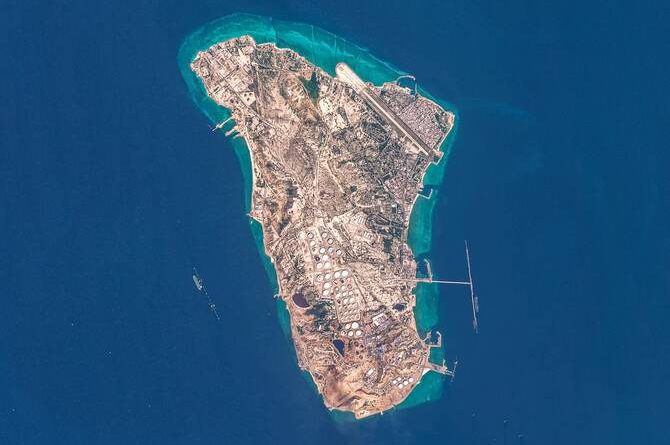
Military analysts warn US control of Kharg Island would carry high troop risk amid Iran tensions
Washington-Efforts by the United States to seize Iran’s Kharg Island would expose American forces to significant operational and retaliatory risks, according to military analysts and former commanders, amid escalating rhetoric from US President Donald Trump over the strategic oil terminal, Arab News reported.
Kharg Island, located about 15 to 16 nautical miles off the coast of Iran, serves as a critical export hub handling roughly 90 percent of Iran’s crude oil shipments, making it a central node in the country’s energy infrastructure and a key source of revenue.
Trump has publicly suggested the United States could take control of the island to assert influence over Iran’s oil and gas sector, while also acknowledging that a ground operation would be difficult and politically sensitive. In remarks cited by US media, he indicated reluctance to deploy ground troops, while suggesting limited military options could still be considered.
The United States military has already conducted strikes on the island earlier this year, targeting more than 90 military installations, including naval mine storage sites and missile facilities, while reportedly sparing oil infrastructure to avoid long-term economic disruption, according to Central Command assessments cited in reporting.
However, analysts cited by Arab News and Reuters warned that any attempt to physically occupy the island would likely escalate the conflict. Experts from the Foundation for Defense of Democracies said an occupation could prolong the war and fail to deliver a decisive strategic outcome.
Former US Central Command commander Joseph Votel was cited as saying that while a relatively small force could theoretically hold the island, such troops would require extensive logistical support and would remain highly vulnerable to attack.
Iranian officials have reinforced defenses around the island, deploying air-defense systems, mines, and other military assets in surrounding waters. Iranian parliamentary speaker Mohammad Bagher Ghalibaf warned that Iranian forces were prepared to respond forcefully to any incursion, including targeting regional infrastructure.
Military analysts also cautioned that any US presence could be exposed to asymmetric tactics, including drone surveillance and propaganda dissemination of battlefield losses, potentially increasing political pressure on Washington.
Despite heightened tensions, Trump has recently indicated a pause in new strikes following what he described as progress in negotiations with Tehran, suggesting that diplomatic channels remain active alongside military signaling.