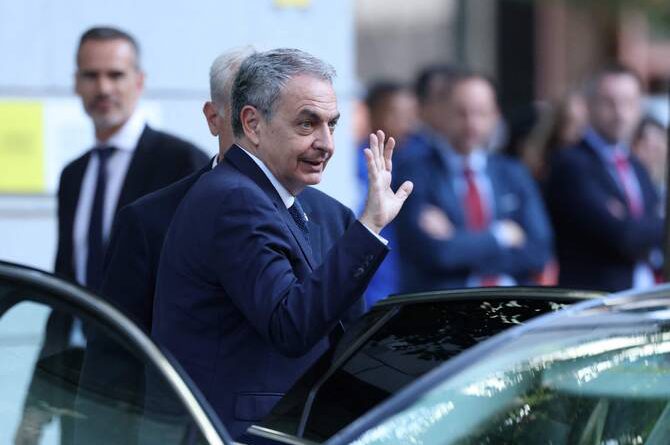
Zapatero Faces Historic Graft Hearing as Corruption Scandals Intensify Pressure on Sanchez
Madrid-Former Spanish prime minister Jose Luis Rodriguez Zapatero appeared before a judge in Madrid on Wednesday in an unprecedented corruption investigation, becoming the first former or serving Spanish premier to be questioned as a suspect in a graft probe, as a series of scandals deepen political pressure on Prime Minister Pedro Sanchez’s minority government.
Zapatero, who led Spain from 2004 to 2011, began the first of two days of hearings at the Audiencia Nacional court over allegations of influence peddling linked to the 2021 state bailout of airline Plus Ultra.
The investigation centers on a 53 million euro ($61.5 million) rescue package granted to the carrier after the COVID-19 pandemic severely disrupted global air travel. Investigating magistrate Jose Luis Calama alleges that Zapatero headed a “stable and hierarchical” network that used opaque financial channels to conceal money flows and secure illicit payments connected to the bailout process.
Zapatero has categorically denied any wrongdoing. Prime Minister Sanchez has publicly expressed his “full support” for the former leader, widely regarded as his political mentor within Spain’s Socialist movement.
The case broadened after police searches of Zapatero’s office reportedly uncovered jewelry and luxury watches valued at approximately 1.3 million euros. The findings prompted investigators to examine potential tax fraud and smuggling offenses in addition to the original influence-peddling allegations.
Individuals close to Zapatero have said the valuables originated from a family inheritance and reject any suggestion of criminal conduct.
The proceedings come at a particularly sensitive moment for Sanchez, whose administration is already confronting multiple corruption investigations involving members of his inner political circle and family.
A separate inquiry into his wife, Begona Gomez, over alleged influence peddling has weighed heavily on the government for two years, with a judicial decision on whether to proceed to trial expected in the coming days.
Legal proceedings are also underway involving former Transport Minister and longtime Sanchez ally Jose Luis Abalos, while another case concerns the prime minister’s brother, David Sanchez.
Additional pressure emerged following reports of a police investigation into a former Socialist activist suspected of orchestrating efforts to obstruct corruption inquiries involving figures linked to the governing party.
The accumulation of legal controversies has weakened the Socialists politically. Since late 2025, the party has suffered four regional election defeats, fueling speculation about the impact the scandals could have on Spain’s next national election.
Sanchez rose to power in 2018 after pledging to restore integrity to Spanish politics following a major corruption scandal that resulted in the conviction of the conservative Popular Party (PP). Opposition parties now argue that the government faces its own credibility crisis and have called for Sanchez’s resignation and an early general election.
The prime minister has rejected those demands and insists he will remain in office until the end of his term in 2027. He has continued to highlight his government’s economic and social policy achievements while avoiding detailed public comment on the ongoing investigations.
Political scientist Astrid Barrio of the University of Valencia said the case carries significance beyond its legal implications because of Zapatero’s symbolic influence within the ruling Socialist Party.
“What is at stake is the reputation of someone who has become the moral beacon of Pedro Sanchez and the current Socialist Party,” Barrio said.
She added that two developments could pose the greatest threat to Sanchez’s political survival: the possibility of the prime minister himself becoming the subject of a formal investigation or prosecutors pursuing allegations of illegal party financing against the Socialists.