Israel’s Somaliland Gamble and the New Geometry of the Red Sea
Somaliland and specifically the Port of Berbera, offers New Delhi an alternative gateway into the region and the broader African hinterland, including landlocked Ethiopia.
On December 26, 2025, Israeli Prime Minister Benjamin Netanyahu raise diplomatic tempers in Middle East by unilaterally recognising the Republic of Somaliland, the breakaway region of Somalia which has been functioning as a de facto state since 1991. This decision goes beyond a diplomatic gesture and signifies a landmark geopolitical move that signals a recalibration of power politics in the Red Sea, the Horn of Africa, and the eastern Mediterranean.
Not only did it break a long-standing international taboo against recognising defacto regions, it also injected new momentum into a region which is increasingly defined by strategic choke points, rival maritime visions, and great-power competition.
Located along the southern edge of the Gulf of Aden, bordering Djibouti, and sitting astride the approaches to Bab el-Mandeb, Somaliland has existed in diplomatic limbo for three decades ago. Its decision to exit political union followed the collapse of Siad Barre’s regime and has since built functioning political institutions while Mogadishu remained mired in civil war, insurgency, and foreign intervention.
It has conducted multiple elections, maintained relative internal stability, issued its own currency and passports, and exercised effective territorial control, which constitute core criteria of statehood under international law. And still, recognition eluded Hargeisa, largely because of international deference to the fiction of Somali territorial unity.
But the December 26 recognition by Israel marks the first major breach in this diplomatic wall. Framed within the broader ethos of the Abraham Accords, which seeks to normalise Israel’s relations with its Arab neighbours, Prime Minister Benjamin Netanyahu’s announcement historically significant elevates Somaliland from diplomatic obscurity and signals that geopolitical utility and governance capacity can, under certain conditions, trump inherited postcolonial borders.
Though this precedent alone makes the decision a watershed moment, yet the true importance of this move lies less in symbolism and more in strategy.
This decision must be read against the backdrop of the Red Sea’s growing militarization in recent years. For instance, the Bab el-Mandeb Strait which connects the Gulf of Aden to the Red Sea and, by extension, the Suez Canal (which opens into Mediterranean Sea) has emerged as one of the world’s most contested maritime chokepoints.
During the prolonged Gaza war that followed Hamas’s October 7, 2023 terrorist attack on Israel, Iran-backed Houthi militia in Yemen repeatedly targeted Israeli-linked shipping, exposing Israel’s vulnerability along its maritime lifelines.
As such, it cannot be divorced from the Israel’s broader post-Gaza recalibration, where it is prioritizing securing maritime routes, diversifying strategic partnerships, and reducing reliance on fragile regional arrangements.
What Somaliland does is it provide Israel a rare strategic advantage in the region where hostile non-state actors have in recent years emerged a significant irritant to its maritime access. Its Port of Berbera can provide Israeli Defence Force (IDF) with potential logistical depth, maritime awareness, and forward presence in Red Sea region and deny any military advantage to hostile actors like Houthis who sit across on the eastern coast of Gulf of Aden.
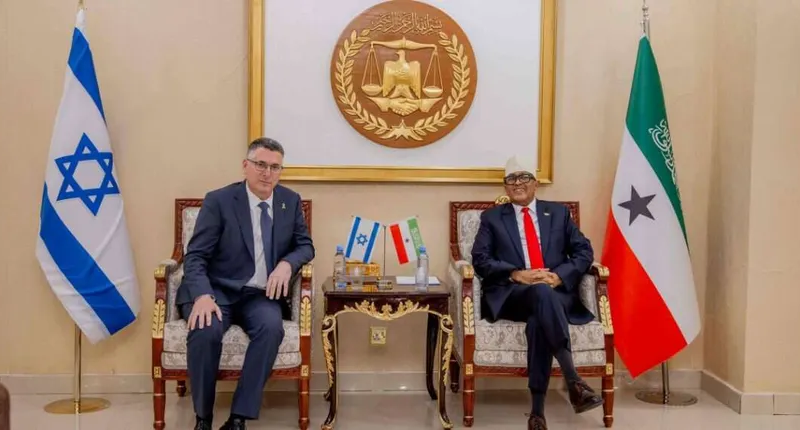
Israel has demonstrated its resolve to grow its relations with Somaliland through the January 7 Hargeisa visit by Foreign Minister Gideon Saar, becoming the first high-level international dignitary to visit the country.
More crucially, this decision followed the 10th trilateral summit of December 23 between Israel, Greece, and Cyprus in Jerusalem, wherein their leaders —PM Netanyahu, PM Kyriakos Mitsotakis (Greece) and President Nikos Christodoulides (Cyprus)— reaffirmed cooperation on energy, security, and regional stability.
These are the areas where all three states have found themselves increasingly at odds with Turkey’s assertive posture in the Eastern Mediterranean region.
Together, these moves, as such, reveal a coherent strategy by Israel to constrain Ankara’s regional ambitions. It is should be noted that Turkey, under President Recep Tayyip Erdogan, has pursued an increasingly revisionist foreign policy, blending neo-Ottoman rhetoric with military deployments and proxy relationships stretching from Libya and Syria to the Horn of Africa.
In the eastern Mediterranean, Turkey’s aggressive maritime claims and unilateral actions have antagonized Greece and Cyprus while undermining cooperative energy frameworks in the region.
In the Horn of Africa, Ankara has followed a similar playbook. By becoming the principal external patron of Somalia’s federal government under President Hassan Sheikh Mohamud, through military training, financial aid, and base access, Turkey has positioned Mogadishu as the cornerstone of its Red Sea strategy.
But this engagement has always been less about Somali stability and more about power projection. It provides Ankara with proximity to Bab el-Mandeb and leverage over one of the world’s most vital maritime corridors through which roughly 12-15 per cent of global trade worth over 1 trillion USD is conducted annually.
Israel’s recognition of Somaliland, therefore, directly undercuts this strategy. It legitimizes an alternative political entity that Ankara has consistently sought to marginalize and weakens Turkey’s monopoly over Somalia’s external partnerships. President Recep Tayyip Erdoğan’s sharp condemnation and calling the move “illegitimate and unacceptable” betrays Ankara’s anxiety that its Horn of Africa foothold may now face meaningful constraints.
But Turkey’s insistence on Somali “unity and territorial integrity” rings hollow when contrasted with its own record of selective sovereignty advocacy for regions like Northern Cyprus. What Ankara fears is not fragmentation per se, but the erosion of its geopolitical leverage in the Red Sea basin.
For India, this decision by Israel carries quiet but significant implications, particularly for the India–Middle East–Europe Economic Corridor (IMEC). The project which has been conceived as a multimodal trade and connectivity initiative linking India to Europe via the Middle East, was disrupted by the Gaza war and this recalibration could ring positively for realising its implementation.
Moreover, Somaliland, and specifically the Port of Berbera, offers New Delhi an alternative gateway into the region and the broader African hinterland, including landlocked Ethiopia. While New Delhi, due to its express commitment to norms based international relations, may be constrained by its adherence to UN norms and is unlikely to formally recognize Somaliland in the near term, Israel’s move expands its strategic options without requiring overt diplomatic commitments.
Equally important is what this means vis-à-vis Turkey. Ankara has consistently positioned itself as an alternative economic and political hub for the Muslim world, often at odds with India’s interests. By weakening Turkey’s strategic depth near the Red Sea, Israel’s move indirectly aligns with India’s interest in a more plural, less Ankara-dominated regional order.
Israel’s recognition of Somaliland is, at its core, a bet: that regional stability will increasingly favor functional governance over inherited legitimacy, maritime strategy over rhetorical solidarity, and coalitions of the willing over paralyzed multilateralism. It challenges Turkey’s negative and destabilizing role in multiple theaters, signals resolve in the face of maritime coercion, and opens new possibilities for partners like India.
While this decision offers Somaliland its long-delayed validation and Israel the strategic depth, it represents a rare diplomatic setback for Turkey. Whether others follow Israel’s lead remains uncertain. But one thing is clear that the Red Sea is no longer a peripheral theatre and this development makes it a focal point of geopolitics in the years ahead.
Disclaimer: Views expressed by writers in this section are their own and do not reflect Milli Chronicle’s point-of-view.