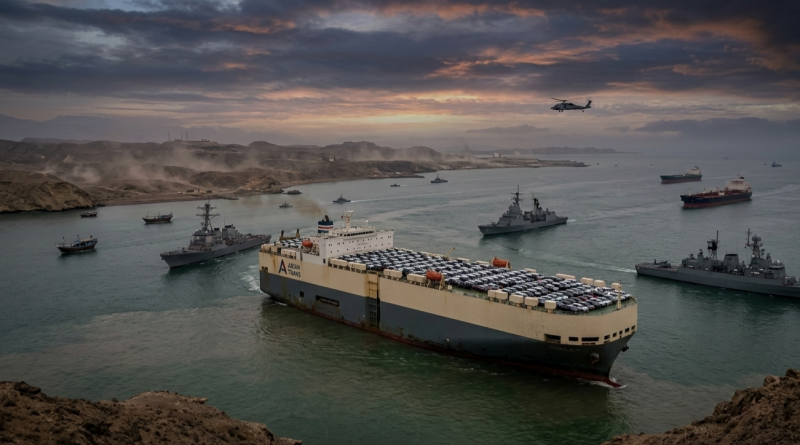
War jitters choke Asian auto shipments through Hormuz
March 6 — The war involving the United States, Israel and Iran entered its seventh day on Friday, threatening to disrupt billions of dollars in vehicle exports from Asia to the Middle East as shipping through the strategically vital Strait of Hormuz halted amid fears of potential attacks by Tehran.
Asian automakers including companies from China, India, South Korea and Japan rely heavily on maritime routes through the Gulf to supply cars to markets across the Middle East, a key destination for exports worth billions of dollars annually.Shipping disruptions along the Hormuz corridor have raised concerns among manufacturers and logistics firms about supply chain delays and mounting delivery backlogs as tensions escalate in the region.Gulf market crucial for Asian exports.
The Middle East has emerged as a critical overseas market for Asian automakers, particularly for Chinese manufacturers seeking to offset weakening domestic demand.According to data from the China Passenger Car Association, Chinese automakers shipped 8.32 million vehicles overseas in 2025. Of that total, about 1.39 million units—roughly one-sixth—were exported to Gulf markets including Saudi Arabia and the United Arab Emirates.The Gulf region is now the second-largest overseas destination for vehicles produced in China, underscoring its strategic importance for the country’s automotive industry.Trade flows from India also highlight the Middle East’s growing role as a major market for Asian-built vehicles.
Commercial customs data show that India exported vehicles worth $8.8 billion in 2025, with approximately 25% of those shipments destined for Middle Eastern markets, primarily Saudi Arabia.Carmakers face exposureMajor global manufacturers operating in Asia are particularly exposed to disruptions along the Gulf shipping corridor.South Korea’s Hyundai Motor has one of the largest exposures through its export operations in India. Around half of its global shipments from India in 2025—valued at about $1.8 billion—were destined for countries in the Gulf region.Japan’s Toyota Motor also relies heavily on Middle Eastern demand for vehicles produced in India.Trade data show that roughly two-thirds of Toyota’s India-based exports last year were shipped to Middle Eastern markets. The company exported about $470 million worth of vehicles from India in total, with more than $300 million of that volume going to Gulf countries.Shipping risks intensifyThe Strait of Hormuz is one of the world’s most critical maritime chokepoints, linking the Persian Gulf with the Gulf of Oman and providing the primary shipping route for energy exports and a wide range of manufactured goods.Any prolonged disruption to shipping through the corridor could have far-reaching implications for supply chains serving Middle Eastern markets.For Asian automakers, the route represents a key commercial artery connecting factories in Asia with dealerships and distribution hubs across the Gulf, making the region’s geopolitical stability a central factor in sustaining export flows.