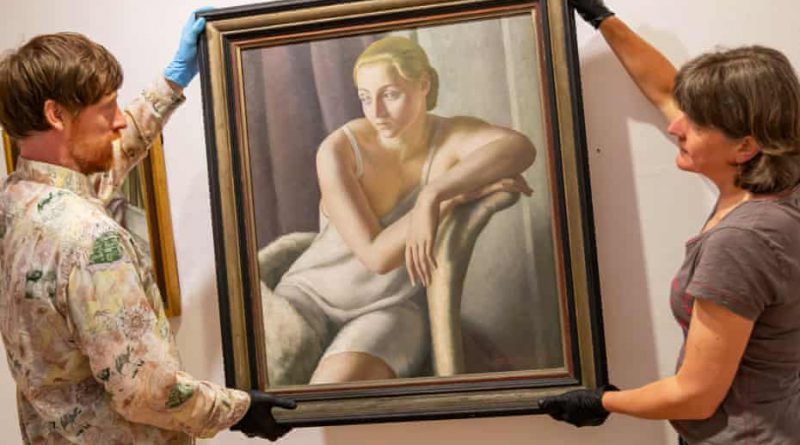
UK Galleries Unite to Spotlight Women Artists in Landmark New Exhibition
“There is still so much more to say about women in art history — and even more to rediscover.”
A major new collaborative exhibition across regional galleries in Britain is bringing long-overdue attention to women artists whose contributions have often been overlooked in traditional museum collections dominated by male names.
Titled Making Her Mark, the project brings together works by some of the country’s most celebrated female artists, including Tracey Emin, Barbara Hepworth, Laura Knight, Elizabeth Forbes, and Gillian Ayres.
The initiative is being shared between Penlee House Gallery & Museum, galleries in Worcester, and Kirkcaldy, creating a rare regional partnership focused entirely on correcting historical imbalance in artistic representation.
For many smaller galleries across the UK, collections have traditionally reflected centuries of inequality in the art world, where male painters and sculptors were more likely to receive commissions, institutional support, and lasting recognition.
As a result, many museum walls still tell a largely male story.At Penlee House Gallery & Museum in Penzance, that reality is especially visible. Known for its strong representation of the Newlyn School and Cornish art history, much of its permanent collection features male artists whose work shaped the region’s artistic identity.
But from this week, visitors entering the gallery will be greeted by something strikingly different.Displayed prominently above a marble fireplace is a bold and emotionally charged work by Tracey Emin, challenging viewers with the raw personal intensity that has made her one of Britain’s most discussed contemporary artists.
In a nearby room hangs a vibrant work by Barbara Hepworth, whose abstract forms and modernist vision helped define 20th-century British art.Together, the works create a conversation across generations from early pioneers to contemporary voices highlighting not only artistic excellence but also the barriers women faced in gaining recognition.
The exhibition also features pieces by Laura Knight, one of the first women elected to full membership of the Royal Academy, and Elizabeth Forbes, often considered one of the leading figures of the Newlyn School despite being historically overshadowed by her male contemporaries.
Textile artist Imogen Bright Moon also contributes to the exhibition, with contemporary tapestry work that adds another dimension to the project’s exploration of female creativity and artistic identity.Curators say the goal is not simply to celebrate famous names, but to encourage visitors to reconsider how art history itself has been written.
For decades, women artists were frequently treated as exceptions rather than central figures. Their work was often categorized as secondary, domestic, or decorative rather than serious fine art. Even highly accomplished artists found themselves remembered mainly in relation to male partners, schools, or movements.Projects like Making Her Mark seek to shift that narrative.
Rather than presenting women artists as a special category separate from the mainstream, the exhibition argues that they have always been central to British art they were simply not always given equal visibility.This rebalancing is especially significant in regional galleries, where local collections shape public understanding of cultural history.
By placing women’s work at the centre of these spaces, the exhibition challenges long-standing assumptions about whose stories deserve prominence.It also reflects a wider movement across museums and cultural institutions to reassess collections, acquisitions, and curatorial practices through a more inclusive lens.
Across Britain and beyond, galleries are increasingly revisiting archives, reattributing forgotten works, and acquiring art by women and other historically underrepresented groups. The process is not only about fairness but also about revealing a fuller and more accurate picture of artistic history.
At Penlee House, the presence of a contemporary Tracey Emin alongside earlier artists such as Barbara Hepworth and Elizabeth Forbes shows how the conversation spans centuries rather than belonging to a single era.It also reminds visitors that progress remains unfinished.
Despite major advances, women artists still face unequal representation in exhibitions, collections, auction prices, and critical attention. Recognition has improved, but parity remains distant.That is why curators describe Making Her Mark not as a conclusion, but as part of a continuing discussion.
The title itself suggests both artistic creation and historical correction women making their mark on canvas, sculpture, and textiles, while also finally making their mark in the institutions that preserve cultural memory.
For visitors walking through the galleries, the exhibition offers something more than visual pleasure. It invites reflection on absence whose work was missing, whose voices were muted, and how different the walls of museums might look if history had been written differently.
By bringing these artists together, Making Her Mark offers a small but powerful act of restoration.It suggests that the question is no longer whether women belong at the centre of British art history, but why it took so long for the walls to show it.