Trump Casts Doubt on New Iran Peace Offer, Warns US Strikes Could Resume
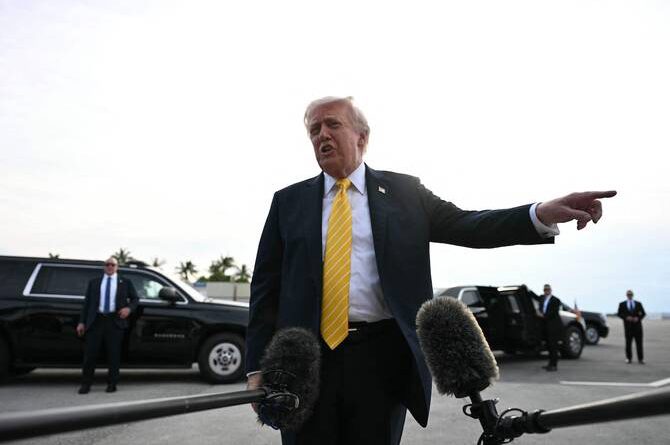
Florida — U.S. President Donald Trump said on Saturday he would review a new peace proposal submitted by Iran but signaled strong skepticism over its chances, while leaving open the possibility of renewed military strikes if Tehran takes actions Washington considers provocative.
The remarks came as diplomatic efforts to end more than two months of conflict between the United States, Israel and Iran remained stalled despite a ceasefire that took effect on April 8 and an unsuccessful round of peace talks held in Pakistan.
Iranian news agencies Tasnim and Fars reported that Tehran had submitted a 14-point proposal to mediator Islamabad aimed at ending hostilities across multiple fronts and establishing a new framework for managing the strategically vital Strait of Hormuz.
“I will soon be reviewing the plan that Iran has just sent to us, but can’t imagine that it would be acceptable in that they have not yet paid a big enough price for what they have done to Humanity, and the World, over the last 47 years,” Trump wrote on his Truth Social platform.
Speaking briefly to reporters in West Palm Beach, Trump declined to define what actions by Iran could trigger another military response but made clear the option remained on the table.“If they misbehave, if they do something bad, but right now, we’ll see,” he said. “But it’s a possibility that could happen, certainly.”
Iranian officials responded by warning that Tehran was prepared for both diplomacy and renewed confrontation.Mohammad Jafar Asadi, a senior figure in Iran’s military central command, said on Saturday that “a renewed conflict between Iran and the United States is likely,” according to Fars News Agency.
“Evidence has shown that the United States is not committed to any promises or agreements,” he said.Deputy Foreign Minister Kazem Gharibabadi told diplomats in Tehran that “the ball is in the United States’ court” and said Iran was prepared for either negotiations or escalation.U.S.
outlet Axios reported earlier this week that Trump’s special envoy Steve Witkoff had pressed for Iran’s nuclear program to be returned to the center of negotiations, adding another layer to already difficult talks.Iran’s mission to the United Nations accused Washington of hypocrisy over nuclear policy, pointing to the United States’ own nuclear arsenal and defending Tehran’s right to uranium enrichment under International Atomic Energy Agency supervision.
“There is no legal restriction on the level of uranium enrichment, so long as it is conducted under the IAEA’s supervision,” the mission said.The standoff has also intensified concerns over global energy markets, as Iran has maintained tight control over the Strait of Hormuz since the war began, severely disrupting one of the world’s most important shipping routes for oil, gas and fertilizer.
The United States has responded with a counter-blockade on Iranian ports, while oil prices have risen roughly 50% above pre-war levels, increasing pressure on global supply chains and inflation-sensitive economies.Iranian lawmakers are now considering draft legislation to formalize new control measures over the waterway.
Parliament Vice Speaker Ali Nikzad said 30% of toll revenues collected under the proposed system would be directed toward military infrastructure, with the remainder allocated to economic development.
“Managing the Strait of Hormuz is more important than acquiring nuclear weapons,” he said.Meanwhile, fighting continued in Lebanon despite a separate truce between Israel and Hezbollah, with Israeli forces carrying out strikes across southern Lebanon after issuing evacuation warnings for nine villages.
Lebanon’s state-run National News Agency reported three deaths, while Hezbollah said it launched retaliatory attacks against Israeli troops.The conflict’s economic toll inside Iran is also worsening, with inflation reportedly surpassing 50% and oil export revenues under sustained pressure.
“Everyone is trying to endure it, but they are falling apart,” a Tehran resident identified only as Amir told AFP, describing growing public anxiety over living costs and economic survival.