US, China Trade Chiefs Clash Over Supply Chain Rules Ahead of Trump-Xi Summit
Washington— Senior U.S. and Chinese economic officials held what both sides described as “candid” talks on Thursday, exchanging complaints over trade restrictions and supply chain policies ahead of a planned summit next month between President Donald Trump and President Xi Jinping in Beijing.
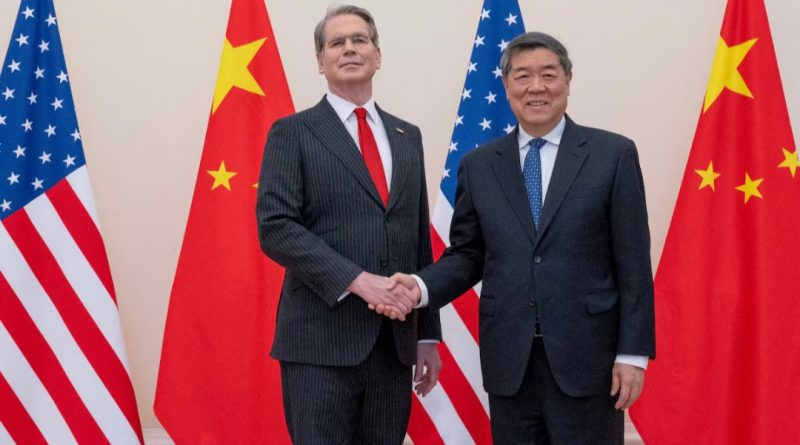
U.S. Treasury Secretary Scott Bessent said he spoke by video call with Chinese Vice Premier He Lifeng and U.S. Trade Representative Jamieson Greer to discuss preparations for Trump’s planned May 14–15 visit to China, which would mark a major diplomatic engagement between the world’s two largest economies.
“Our meeting was both candid and comprehensive, and I stressed that China’s recent provocative extraterritorial regulations have a chilling effect on global supply chains,” Bessent said in a post on X.
His remarks marked one of the Trump administration’s clearest public criticisms of Beijing’s newly introduced supply chain regulations, which U.S. businesses and analysts say could make it harder for foreign firms to diversify sourcing of critical minerals and industrial goods away from China.
The rules, introduced in recent weeks, create a legal framework that could penalize foreign companies shifting supply chains out of China, particularly in sectors involving rare earths and strategic manufacturing inputs.Analysts have described the move as a significant escalation that could complicate Washington’s broader effort to reduce dependence on Chinese-controlled supply chains.
Bessent did not outline a direct U.S. response to the measures but said he looked forward to “a productive summit” between Trump and Xi.Chinese state broadcaster CCTV said He Lifeng had “candid, in-depth and constructive exchanges” with Bessent and Greer and that Beijing had raised “serious concerns” over recent U.S. trade-restrictive measures targeting China.
According to CCTV, both sides agreed to enhance consensus, manage differences and strengthen cooperation, signaling that preparations for the summit remain on track despite persistent tensions.The officials last met in person in Paris in March, where they discussed possible Chinese purchases of U.S. agricultural goods and the creation of new joint mechanisms to manage trade and investment disputes.
Chinese officials also used those talks to object to new tariff investigations launched by Trump’s administration after the U.S. Supreme Court struck down his earlier global tariff framework in February.Trump had delayed his Beijing trip because of the U.S.-Israeli war involving Iran, but officials on both sides now appear focused on preserving stability ahead of the summit.
In a separate diplomatic exchange on Thursday, Chinese Foreign Minister Wang Yi told U.S. Secretary of State Marco Rubio that Taiwan remained the “biggest point of risk” in bilateral ties, underscoring broader geopolitical tensions beyond trade.
The two countries reached a fragile trade truce last October during talks in Busan, South Korea, after months of retaliatory tariffs triggered by Trump’s “Liberation Day” duties and China’s restrictions on exports of rare earths and other critical minerals.
As the summit approaches, U.S. lawmakers and industry groups are also pressing the administration not to grant China greater access to the American automotive sector.Ten U.S. steel industry groups wrote to Bessent, Greer, Rubio and Commerce Secretary Howard Lutnick on Thursday, warning against allowing Chinese investment into the U.S. auto market.
The groups said such access could weaken domestic manufacturing competitiveness and create national security risks linked to data collection and strategic industrial dependence.At the same time, both governments have continued to build leverage ahead of the leaders’ meeting, with China advancing its new supply chain rules and Washington tightening restrictions on tool shipments to one of China’s major semiconductor manufacturers.
Chinese state media said both sides had expressed willingness to promote the “healthy, stable and sustainable development” of bilateral economic and trade relations.